



Moving into a care home: the checklist



Moving into a care home: the checklist
Moving into a care home is rarely just a practical matter. In most cases you are arranging it for your father or mother while still adjusting to the idea yourself. This checklist walks you through it step by step — the paperwork, furnishing the room, and the move itself — so nothing slips through the cracks and there is time left for what actually matters.
At the bottom of this page you can download and print the full checklist as a free pdf. No sign-up, no email address required.
This guide is written for Belgium. The administrative steps refer to Belgian institutions; the practical and furnishing advice applies anywhere.
1. Planning & paperwork
2 to 3 months ahead- End the current housing. Terminate the lease within the correct notice period, or start the sale. Check whether a termination fee applies.
- Utilities. Cancel or transfer water, gas, electricity and internet. Record the meter readings on the day of departure.
- Change of address. Notify the municipality, the bank, insurers and the pension service.
- Health insurance fund & insurance. Report the move and check whether family liability and hospitalisation cover need adjusting.
- Regional care allowance. Notify the relevant body — Vlaamse Sociale Bescherming in Flanders, AViQ in Wallonia, Iriscare in Brussels. Entering a care home can change the allowance.
- Mail forwarding. Activate bpost's forwarding service so post follows automatically to the new room.
- Subscriptions. Newspapers, magazines, phone plans and memberships: cancel or transfer.
- Contact the care home. Ask for the room layout and what may be brought along. Every care home sets its own rules about personal furniture.
2. Measuring the room and deciding what comes along
1 to 2 months aheadThis is the step that most often goes wrong. A care home room is considerably smaller than the living room at home, and the layout is largely fixed: the bed, bedside table and wardrobe are usually already in place. Whatever you bring has to fit in the space left over and remain usable with a walking frame beside it.
What to measure and ask about
- The genuinely free floor area once the bed and wardrobe are in place — not the total room size.
- The route in. Door width, lift height and the turn in the corridor decide whether a chair can physically get there.
- Socket positions. An electric chair needs one, and the cable must not cross the walking route.
- Turning space to keep around the chair for a walking frame or wheelchair.
- The care home's own requirements. Ask explicitly whether castors are mandatory and what rules apply to the fire safety of the upholstery. This differs per institution and is often only checked on delivery.
Seating: the detail that makes the difference
The familiar chair from home seems the obvious choice, but it rarely is. A classic recliner is usually too deep and too low: once seated, getting up again without help becomes impossible. That is precisely what costs independence — and means waiting for a carer over something small.
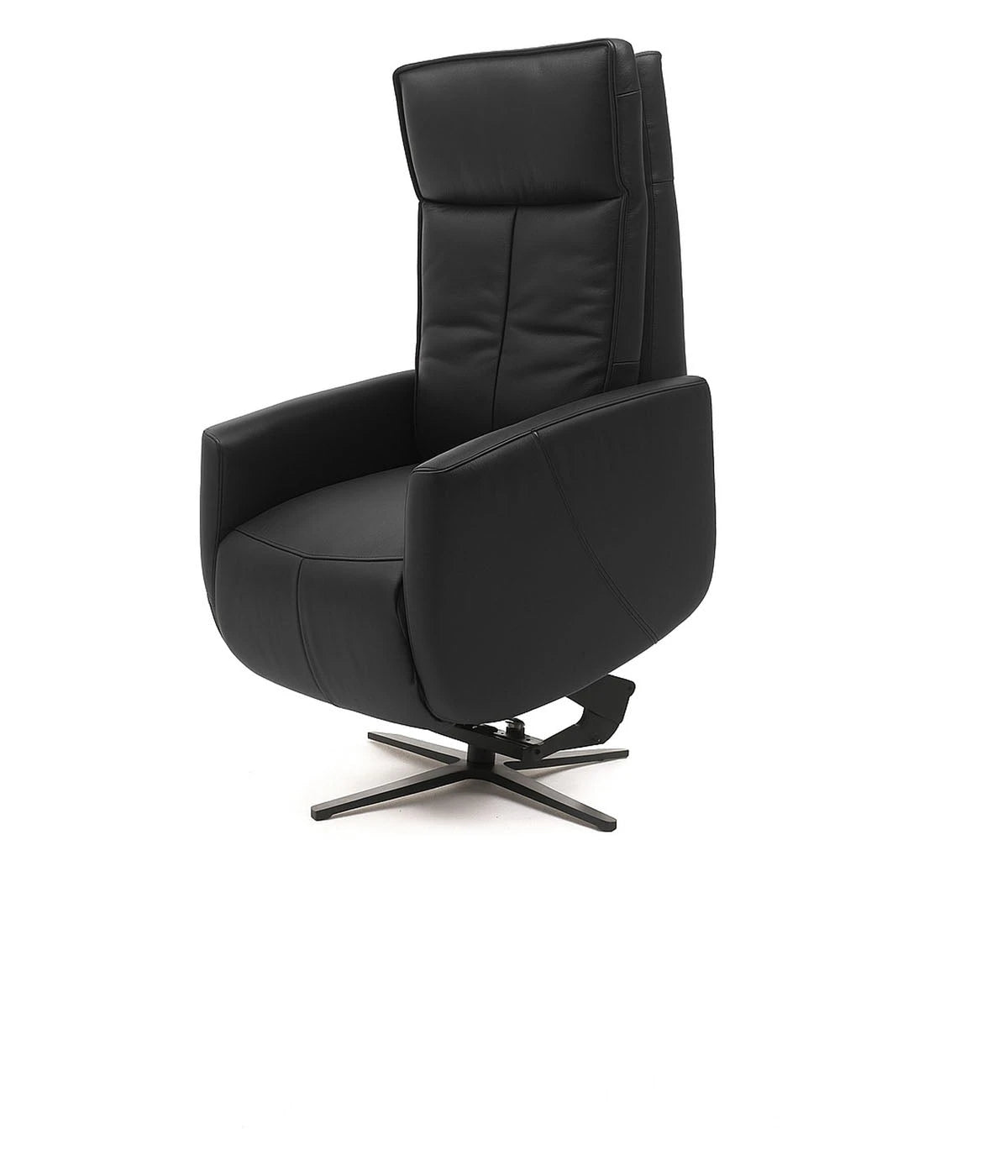
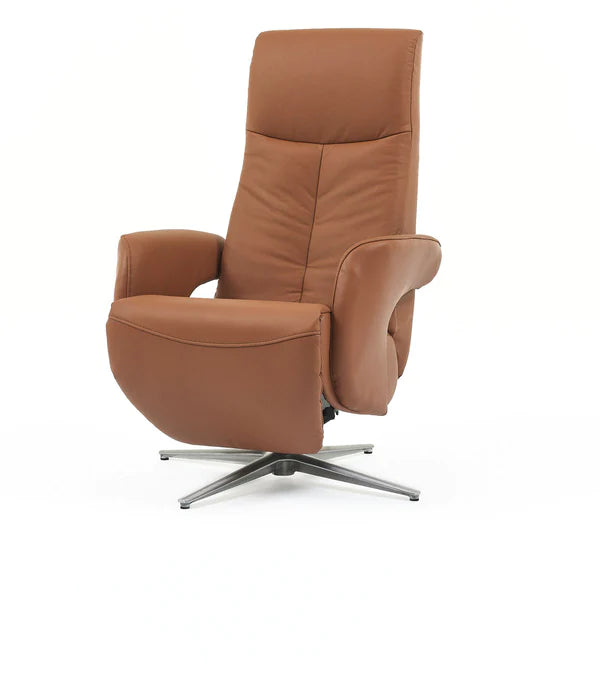
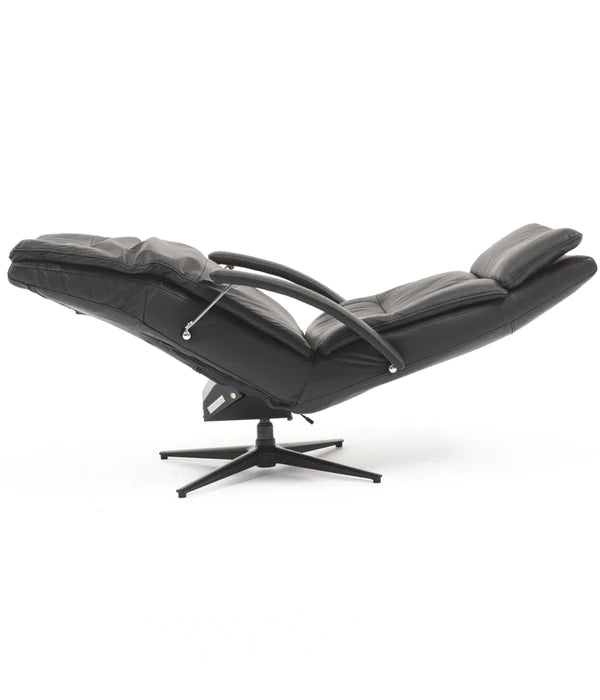
A riser recliner solves this. The chair tilts forward electrically and brings the user to a near-standing position in a controlled way, without loading the knees or hips.

The Medicare — our chair for the care home
The Medicare is built specifically for a care environment. The upholstery is washable and urine-resistant, which often makes the difference between a chair that lasts years and one that needs replacing after six months. The chair sits on castors, so care staff can move it easily for cleaning or care — a condition many care homes impose.
The handset deliberately has only two buttons. For someone less comfortable with technology, that is a considerable advantage.
View all riser recliners ›Does the user weigh more than 90 kg, or is the room very narrow? The Medicare DUO goes up to 110 kg and has two motors with an extra-high footrest. The Sereno is the narrowest model at 74 cm and has a swivel function, but no castors. Compare all three on our comparison page.
Sorting through belongings
- Select for use and for attachment. Bring a few things with no practical function that still evoke home — a clock, a painting, a photograph.
- Sort into four piles: into the room, to family, to sell, to donate.
- Do it together, not in advance. Clearing out belongings while your parent is absent often feels like a loss added on top of a loss.
3. Preparing for the move
2 weeks ahead- Label the boxes. Write the contents on the side, not the lid — stacked boxes are otherwise unreadable.
- A separate bag for the first 48 hours: medication, ID card, health insurance details, toiletries, slippers and two days of clothing.
- Set aside the aids. Walking frame, hearing aid, glasses, dentures, plus the matching chargers and batteries.
- Medical file. Make sure the medication schedule is current and hand it to the head nurse of the ward.
- Name labels in clothing. Almost every care home requires this for the shared laundry. Order enough well in advance.
- Schedule delivery of new furniture. Have a new chair or bed delivered on the day itself or just before, so the room is finished straight away.
4. Moving day
- Put one person in charge of coordinating with the movers. More voices giving directions only makes the day more chaotic.
- Set up the resting spot first. Chair and bed into position before anything else, so there is somewhere to sit while the rest happens.
- Safety check. Tuck the cables of electric chairs and beds neatly along the wall — loose cords are among the most common causes of falls.
- Take time over the welcome. The introductory conversation with the occupational therapist and carers shapes how well the care is tailored.
- Leave the heavy work to others. Your main job today is being there, not carrying boxes.
5. The first few weeks
- Make the room personal. Hang photos and familiar decoration. A room still bare after a week keeps feeling like a hospital room.
- Technical check. Confirm all functions of the riser recliner work and the handset stays within reach.
- Agree fixed visiting times. Predictability helps more than long visits at irregular hours.
- Adjusting is normal. Only after two or three weeks does it become clear what works. Moving furniture around or bringing something extra is not a failure.
Free room check
Not sure whether a chair will fit? Send us the measurements — free width and depth, door width and where the socket is — and we will tell you which model fits and which does not. Free and without obligation.
Send us your measurements › Try one in our Roeselare showroom ›Why families call us for a care home move
- Stock held in Belgium. Our entire stock is here, so we deliver quickly — which matters once the admission date is fixed.
- You choose the delivery day. Saturdays included, so delivery lines up with the move.
- Our own repair service, 7 days a week. We come to the care home; the chair never has to be sent back to us.
- 30-day returns. If the chair turns out not to suit the room, we take it back.
- 22 years of experience in ergonomic seating for seniors, since 2004.
Download the checklist as a pdf
Printable across 3 pages, with tick boxes. Easy to share with siblings or with the care home.
Download the checklist (pdf) ›Frequently asked questions
Can I bring my own furniture into a care home?
Usually yes, but the rules differ per care home. Bed and wardrobe are often provided and cannot be replaced; a personal chair, bedside table and decoration are generally allowed. Ask at admission, and request the free dimensions of the room at the same time.
Which riser recliner fits in a care home room?
Look at three things: external width, whether the care home requires castors, and whether the upholstery has to be washable. The Medicare is built around those last two points. If the room is very narrow, the Sereno is the narrowest alternative at 74 cm. Allow roughly 40 cm of free space in front of the chair for the footrest.
Does the health insurance fund reimburse a riser recliner?
Contributions exist, but conditions differ per fund and per situation. We have collected the options on our page about reimbursement and financial support.
How quickly can a chair be delivered to a care home?
Our entire stock is held in Belgium, so we can usually deliver within a few days. You choose the delivery day, Saturdays included. Delivery is made directly to the room.
What if the chair does not fit after all?
You have a 30-day right of return. Send us the room measurements beforehand via our free room check and you will know in advance.